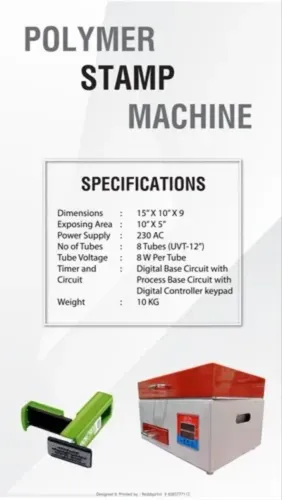

Tube count alone does not tell you how large a stamp plate a machine can expose or how many finished stamps it will produce per hour. By comparing exposure uniformity, cycle time, operating costs, maintenance, and your actual plate layout, you can decide whether one tube is sufficient or a two-tube configuration earns its added cost.
Key takeaways
- A second tube fires with the first; it is not a standby lamp.
- Compare exposure area and measured cycle time, not tube count alone.
- Check power draw, heat, noise, workspace, and tube replacement costs.
- Run a timed acceptance test using your stamp size and exposure settings.
What Does the Second Flash Tube Actually Change?
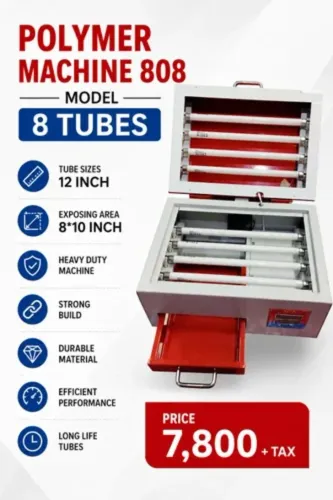
A second tube does not automatically make flash tube exposure twice as fast, and it is not a spare lamp. In a two-tube flash stamp making machine, both tubes normally fire in the same cycle; capacitor energy and discharge control determine whether that cycle becomes shorter.
Many machines use the second tube to spread light across a wider working field instead. A one-tube flash stamp making machine can match that result for smaller plates.
| Feature | One-tube flash stamp making machine | Two-tube flash stamp making machine |
|---|---|---|
| Exposure speed | May suit the rated plate size without reducing cycle time | May shorten exposure, but often maintains a similar cycle time while covering more area |
| Working area | Depends on tube length, reflector shape, and lamp-to-plate spacing | Can provide a broader field when both lamps are correctly positioned |
| Exposure uniformity | Strong when the plate fits the designed field | Improves across a larger plate only when the tubes are matched and balanced |
| Lamp failure | Stops exposure or produces a partial result | Does not provide reliable backup; one failed tube can leave part of the plate underexposed |
Check the manufacturer’s stated uniform working area, not just the outer platen size. A poorly balanced dual-tube machine can create a bright band beside one lamp or a darker centre, changing engraving depth across one stamp.
Ask for a rated exposure range or calibration procedure for your exact plate material. Tube count and nominal wattage do not transfer reliably between plate brands.
Finally, confirm whether the machine detects a failed tube and blocks production. Without that safeguard, a nominally complete exposure can create rejects that look like artwork or film errors.
Compare Exposure Area and Cycle Time Instead of Tube Count
A two-tube machine earns its price through more usable exposure area or shorter completed cycles—not through lamp count. Ask for the flash stamp exposure time for your exact plate material, the exposure range, and whether both tubes fire together. A fast flash is irrelevant if capacitor recharge time leaves the machine waiting between plates.
| Specification | One-tube reading | Two-tube reading | Why it matters |
|---|---|---|---|
| Usable exposure area | Uniform field within the stated platen size | Larger uniform field only if the reflector and tube layout support it | Compare this with your largest plate, not the outer platen dimensions |
| Flash exposure time | Rated time for your plate thickness and film density | Confirm whether both tubes reduce time or cover separate areas | Tube count does not predict exposure speed |
| Repeat cycle | Flash time plus capacitor recharge and cooling | Flash time plus recharge, cooling, and any dual-tube duty limit | This determines sustained output |
| Electrical data | Capacitor-bank energy, trigger method, and recharge time | The same figures, measured with both tubes operating | Input voltage alone cannot predict production |
Calculate stamps per hour from the complete cycle: loading, alignment, masking, exposure, unloading, and cutting. If each stamp is handled separately, a larger exposure field may add little output. Compare the resulting figure with your daily batch size.
Request a calibration procedure using your chosen plate brand. Plate thickness, coating, pore structure, and spectral sensitivity change the required flash stamp exposure time, so nominal wattage cannot be transferred reliably between materials. Also price total cost per exposed plate, including electricity, cooling requirements, and tube replacement.
How the Exposure Workflow Affects Stamp Quality
A clean, durable stamp depends less on tube count than on a controlled flash stamp making process: opaque film, firm contact, matched exposure, and a material-specific cure. A second tube helps only when it distributes light evenly across the usable field; it cannot repair poor artwork film preparation.
1. Make the film black enough to block the flash in non-image areas. Remove dust, pinholes, curled edges, and translucent toner, then press the film tightly against the plate. Any gap scatters light and softens fine text.
2. Set the exposure from the plate supplier’s range, not from tube count. Underexposure leaves non-image areas unsealed, causing background ink leakage and dirty impressions. Overexposure can close image pores, harden the plate, and produce faint prints.
3. Confirm that both lamps fire together on a two-tube machine. A failed trigger circuit, connector, or tube can expose only part of the plate unless the machine detects the fault and blocks the cycle.
4. Inspect the finished flash stamp plate across its full working area. Look for equal engraving depth from edge to edge, open image pores, sealed background areas, and crisp small lettering.
| Option | Quality checkpoint | Failure to catch |
|---|---|---|
| One tube | Even light across the specified field | Edge areas cure differently |
| Two tubes | Matched position, output, and timing | Bright bands or a darker centre |
| Either option | Repeatable exposure time and film contact | Inconsistent stamps from one batch |
Account for Power, Heat, Noise, Space, and Tube Replacement
A second tube earns its price only when its extra output offsets higher machine power consumption, heat, noise, floor space, and parts cost. Two tubes also add a lamp, trigger circuit, reflector, connector, and discharge path that can fail.
| Option | Ongoing ownership difference | Cost or risk to calculate |
|---|---|---|
| One tube | Fewer consumables and simpler flash stamp machine maintenance | Lower replacement-part count and easier fault finding |
| Two tubes | More heat, electrical demand, and components | Add both tubes’ flash tube replacement cost and service labour |
| Either option | Xenon flash tube life declines with use and discharge stability can worsen | Budget replacement before exposure becomes visibly weak |
Do not treat the second tube as automatic backup. Unless the machine detects a failed tube and blocks production, one failed lamp can expose only part of the plate and create rejects that resemble artwork or film errors. Ask Sun Graphics whether its two-tube model gives a fault indication and whether both tubes fire together.
1. Record the machine’s input power, rated cycle time, recharge time, noise level, dimensions, and ventilation clearance. Calculate electricity from input kilowatts multiplied by operating hours, not from tube count.
2. Request a documented exposure range or calibration procedure for your exact plate material. Wattage does not transfer reliably between brands with different thickness, coating, pore structure, or spectral sensitivity.
3. Price replacement tubes, trigger components, reflectors, and technician time over the expected xenon flash tube life. Compare that total cost per exposed plate with the one-tube option, including rejects from uneven exposure.
Related products
 | Flash Stamp Making Machine ₹8500 2 Tube Model The 2 Tube Flash Stamp Making Machine is a reliable and efficient solution for manufacturing high-quality flash stamps quickly and... View product → |
 | Flash Stamp Making Machine Flash Stamp Making Machine 1 Tube Model ₹7500 Flash Stamp Making Machine (1 Tube) – Product Description Flash Stamp Making Machine – 1 Tube Model The 1 Tube Flash Stamp Making Machine is an... View product → |
Use a Practical Buying Rule and a Measured Acceptance Test
Choose a one-tube machine when its stated uniform working area covers your largest plate, its recharge time meets your required stamps per hour, and exposure calibration works with your chosen plate material. It is sufficient for steady, smaller-format work when downtime from a failed tube is acceptable.
Treat tube count as a configuration detail, not the decision. A two-tube machine justifies its higher cost only if it delivers more usable area, shorter repeatable cycles, or better edge-to-center results at your actual production rate. Do not accept nominal wattage as proof.
Run this acceptance test before purchase:
- Request the manufacturer’s exposure range for your exact plate brand, thickness, film, and material sensitivity.
- Expose identical test patterns at the centre and four edges of the largest advertised plate size.
- Run the same plate through the complete washout, drying, and inking process used in production.
- Compare background sealing, fine-line retention, impression density, and engraving depth across all five positions.
- Repeat the test after several cycles and record exposure time, recharge time, and any brightness band near either tube.
This plate uniformity test exposes a poorly balanced dual-tube system, where one side engraves deeper or the centre remains weak. In a one tube versus two tube comparison, choose the two-tube option only when its measured gain covers the added power, space, tube replacement, and trigger-component costs.
A reliable flash stamp machine buying guide therefore ends with repeatability at your intended plate size, not a tube count.
Frequently asked questions
Does a second flash tube make a machine twice as fast?
No. Both tubes normally fire in one cycle, while capacitor energy and discharge control determine cycle time.
What should you compare instead of the number of tubes?
Compare the usable exposure area, measured cycle time, exposure uniformity, and the stamp sizes you produce.
How does the exposure workflow affect stamp quality?
Consistent film contact, clean glass, correct exposure settings, and even light across the sheet help prevent weak or overexposed stamp areas.
What should a buying acceptance test measure?
Time several complete cycles with your normal stamp layout, then inspect exposure uniformity, heat, noise, power requirements, and repeatability.
Related products
 | Flash Stamp Making Machine Automatic (2 in 1 Model) ₹13500 Flash Stamp Making Machine Automatic (2 in 1 Model) – Heavy Duty Automatic Flash Stamp Making Machine – 2 in 1 Model The Automatic Flash Stamp Making... View product → |
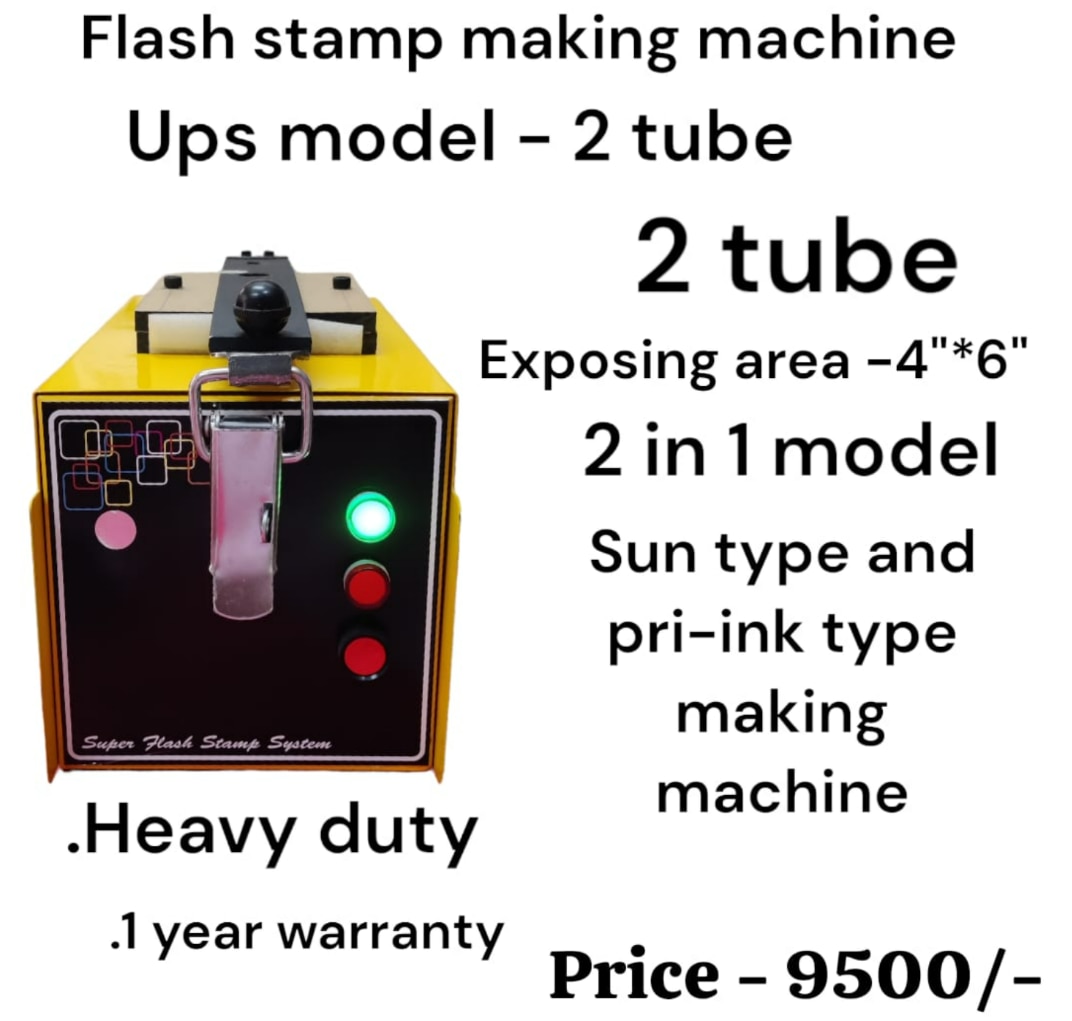 | Flash Stamp Making Machine Flash Stamp Making Machine (UPS Model – 2 Tube) ₹9500 Flash Stamp Making Machine (UPS Model – 2 Tube) Specification Details Product Name Flash Stamp Making Machine Model UPS Model – 2 Tube Type 2-in-1... View product → |