

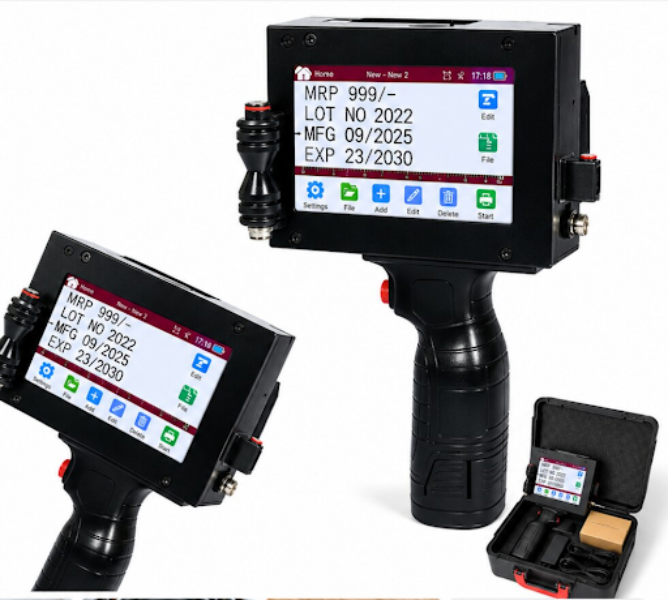
Small manufacturers and packaging operations do not always need a fully automated production line to mark cartons, bags, labels, and other surfaces. In situations involving smaller batches, changing products, irregular packaging, or limited production space, a Hand Handle Printer can provide a more flexible marking approach.
Choosing the right unit, however, requires more than comparing purchase prices.
Start With the Surface Being Printed
The substrate is one of the first considerations.
A business may need to print on:
- Corrugated cartons
- Paper packaging
- Labels
- Plastic surfaces
- Pouches
- Wooden packaging
- Selected metal surfaces
- Industrial components
Ink behaviour can differ considerably between porous and non-porous materials.
A system that performs effectively on cardboard may require different ink characteristics when used on plastic or coated packaging. Testing the actual substrate before finalising a solution is therefore valuable.
Define the Information You Need to Print
Not every operation prints the same type of data.
Typical requirements include batch numbers, manufacturing dates, expiry dates, product codes, prices, identification details, and short text.
Businesses should determine the maximum print area, character size, number of lines, and frequency of information changes.
This prevents paying for unnecessary capabilities while also reducing the risk of choosing equipment that cannot accommodate future requirements.
Consider Operator Movement
A handheld system is valuable largely because of its mobility.
If cartons are stacked at different positions or products cannot conveniently pass through a fixed printing station, portable equipment may simplify the process.
The printer should still be comfortable to hold and easy to position consistently.
For frequent daily printing, ergonomics become more important because an uncomfortable device can reduce operator efficiency.
Evaluate Print Consistency
Handheld operation naturally introduces more operator involvement than a fixed automated coding system.
Users should therefore evaluate how easily the printer can maintain a readable impression when moved across the intended surface.
Training employees in consistent movement and positioning can improve results considerably.
Check Consumable Availability
Purchase cost is only one part of equipment ownership.
Ink and other consumables contribute to ongoing operating costs. Businesses should understand expected cartridge usage, storage requirements, compatibility, and replacement availability.
For manufacturers in Delhi and other industrial areas of the National Capital Region, convenient access to compatible consumables can reduce production interruptions.
Compare Handheld Equipment With Fixed Coding
A handheld unit can make sense for low-volume production, multiple package sizes, warehouse marking, mobile applications, and operations where installing a conveyor-based system would be unnecessary.
Higher-volume continuous lines may benefit more from fixed coding equipment integrated into production.
The decision should therefore reflect actual output rather than simply choosing the more technologically advanced option.
Assess Supplier Support
Equipment should be evaluated together with installation guidance, operating instructions, consumable support, and basic troubleshooting assistance.
Sun Graphics manufactures printing and stamp-making equipment for businesses assessing practical marking solutions for varied production requirements.
Before purchasing a Hand Handle Printer, test the intended packaging material, define the required print content, estimate daily usage, and understand recurring consumable costs. This evaluation provides a much clearer basis for selecting equipment that fits real production conditions rather than relying on specifications alone.